How can one be Persian ?
Short film – 2026
Photo and video archives, generative artificial intelligence Direction, writing, editing, visual effects, music: Sebastien Loghman
SYNOPSIS
Born in France to an Iranian father, I engage in a dialogue with an artificial intelligence that becomes the framework for an identity investigation. Between family archives and generated images, the film explores an “identity and a half.”
WATCH THE FILM PROTOTYPE :
How Can One Be Persian? / Video – 2026
OPLINEPRIZE #18
Text by Hafida JEMNI DI FOLCO, curator / juror
MAY 2026
As part of the 18th edition of the OPLINEPRIZE, I am pleased to present the film How Can One Be Persian?, directed by visual artist Sébastien Loghman, who was born in France to an Iranian father.
In this short film, he turns to an artificial intelligence to investigate what it means, for him, to be “Persian” today.
The AI is neither the film’s enemy nor a mere technological gadget. It is treated as a character, a genuine partner in exchange, even in dialogue. The artist questions it through simple, direct questions:
“Who am I?
What does a Persian person born in France look like?
What does my father’s house in Tehran look like?”
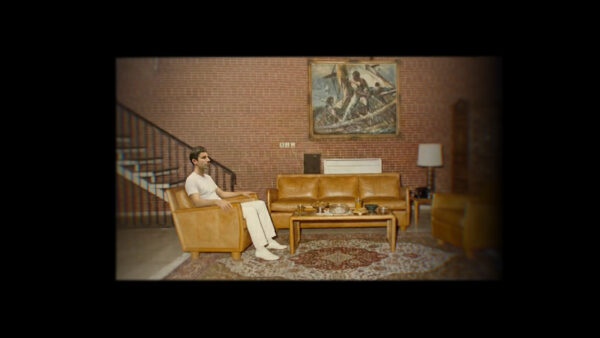
The AI responds using its own means and tools: images, narratives, summaries. The film, meanwhile, shows a family film shot on 16mm. The film emerges from the clash between an image that is plausible but entirely fabricated, and an intimate archive that is equally constructed, yet charged with memory.
Throughout the film, two types of images respond to one another:
- family archives: videos, photographs, fragments of voices;
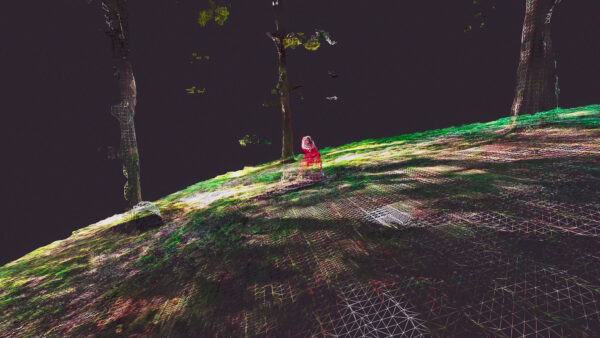
- AI-generated images: portraits, landscapes, reconstructions of scenes.
Neither of these two sources is the truth.
The archive is already a partial, situated staging; the generated image is entirely fictional, yet credible.
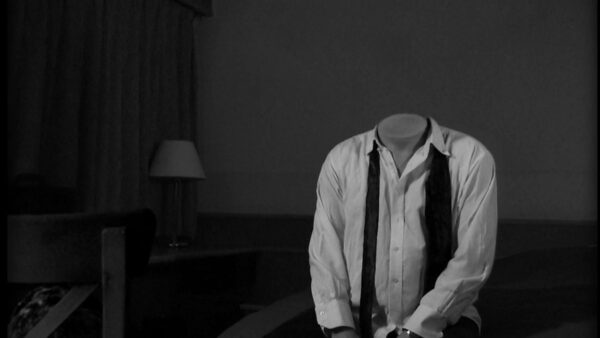
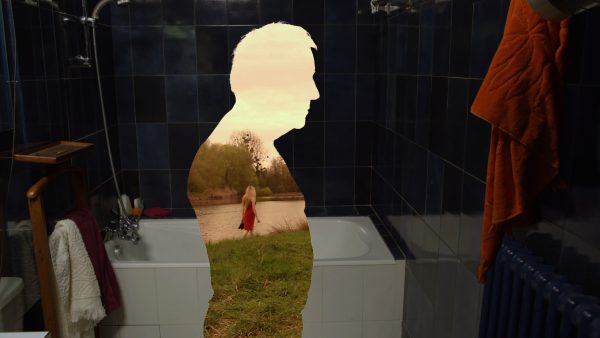
The film’s central driving force lies in the gap between the two: between what the AI projects onto him and what his own traces reveal.
To reflect on this gap, the artist draws on the notion of an “identity and a half.”
He does not experience himself as half-French, half-Iranian, but as something that exceeds these categories.
This “and a half” encompasses everything that escapes identity papers and boxes, but also algorithms:
the family’s silences, misunderstandings of language, the memory of exile, the political situation, shame at times, pride as well, and humor.
The AI, by contrast, has to simplify in order to function. It categorizes, stabilizes, and proposes a coherent version of what he should be, drawing on images and narratives produced primarily in Europe and the United States.
The film does not seek to condemn it, but rather to reveal this friction: on one side, an identity experienced as excessive, as “and a half”; on the other, a machine that, by its very nature, reduces and categorizes.
The title, How Can One Be Persian?, directly echoes Montesquieu’s Persian Letters. In the eighteenth century, this question already expressed European astonishment at the Other—a form of exoticization, but also a play of mirrors: through imaginary Persians, Montesquieu was in fact observing French society.
In 2026, the film shifts this device: it is no longer a fictional Persian commenting on the West, but an AI trained predominantly on Western sources attempting to define what a modern Persian is. In this way, the algorithm takes up, in its own manner, the position of the European gaze in Montesquieu: it fabricates a synthetic Persian character, whom the film then questions, destabilizes, and contradicts. The project therefore enters into dialogue with Montesquieu while relocating his device within the field of contemporary image-making and narrative technologies.
Formally, How Can One Be Persian? is an essay film:
- a dialogue between the artist’s voice and the machine’s voice;
- a constant back-and-forth editing process: whenever the AI produces a synthesis of his identity, an intimate archive comes in to fracture it, nuance it, or contradict it;
- moments of glitches, misunderstandings, or silence, when neither the AI nor the narrator is able to reach a conclusion.
The narrative is constructed precisely through these fractures. The AI is not a backdrop, but a genuine dramaturgical partner: its responses shape the structure of the film, while the images and the artist’s voice continually correct, divert, or sometimes embrace its propositions.
The film is written as a two-voice investigation—human and machinic—in which neither possesses the key. The staging organizes their dialogue so that what remains untranslatable, this “identity and a half,” becomes the true narrative center.
The artist does not ask the AI to tell him who he is; he asks it to show where it stops. The film begins precisely there: in this zone that escapes both the machine and his own narrative, because it is in perpetual motion—and which, perhaps, constitutes his way of being Persian today.
SCREENINGS
2026
OPLINEPRIZE – Contemporary Art and New Media Prize – Nuit Blanche de Paris
- Presentation of the film at the Côté Court Festival, as part of the roundtable “AI and Staging: What’s (Really) New?” A critical discussion with filmmakers based on their experiments. Organized and moderated by the SRF (Société des Réalisateurs de Films).