As part of the 18th edition of the OPLINEPRIZE, I am presenting the film “How Can One Be Persian?”, directed by visual artist Sébastien Loghman, born in France to an Iranian father.
In this short film, he addresses an artificial intelligence in order to investigate what it means, for him, to be “Persian” today.
AI is neither the enemy of the film nor a mere technological gadget. It is treated as a character, a true conversational partner, even a dialogue partner. The artist questions it through simple, direct questions:
“Who am I?
What does a Persian born in France look like?
What does my father’s house in Tehran look like?”
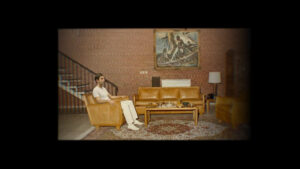
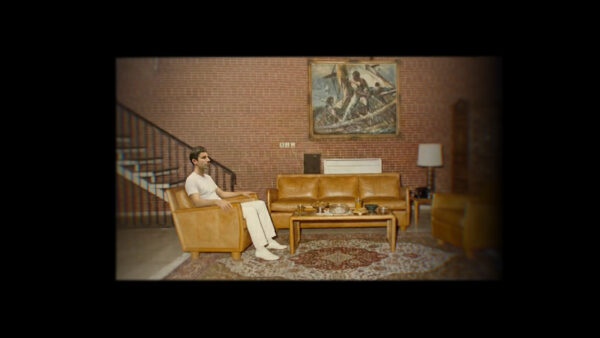
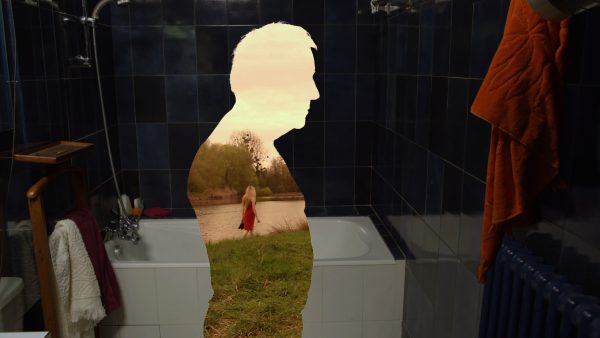
The AI responds with its own means and tools: images, narratives, summaries. The film itself presents 16mm family footage. The film emerges from the collision between a plausible image, entirely fabricated, and an intimate archive, equally constructed, yet charged with memory.
Throughout the film, two kinds of images respond to one another:
– family archives: videos, photographs, fragments of voices;
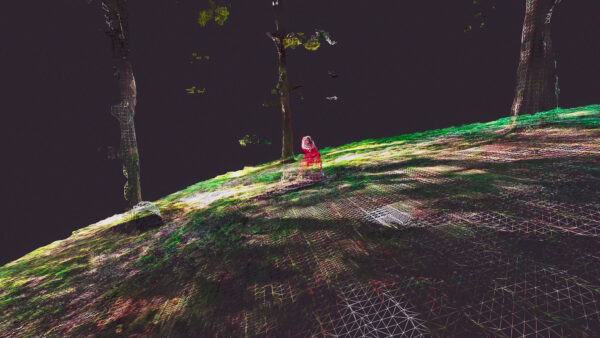
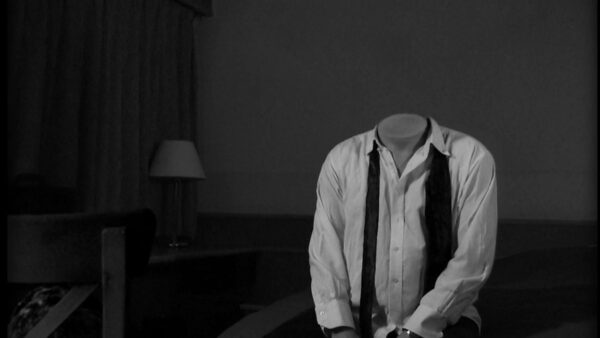
– AI-generated images: portraits, landscapes, reconstructed scenes.
Neither of these two sources is the truth.
The archive is already a partial, situated staging; the generated image is entirely fictional, yet credible.
The core of the film lies in the gap between the two: what AI projects onto him and what his own traces reveal.
To think through this gap, the artist draws upon the notion of “one-and-a-half identity.”
He does not experience himself as half French, half Iranian, but as something that exceeds these categories.
This “and a half” encompasses everything that escapes identity papers, boxes, and also algorithms:
family silences, linguistic misunderstandings, the memory of exile, the political situation, sometimes shame, also pride, and humor.
AI, however, must simplify in order to function. It classifies, stabilizes, and proposes a coherent version of what he should be, relying largely on images and narratives produced in Europe and the United States.
The film does not seek to denounce AI, but to reveal this friction: on one side, an identity experienced as excessive, “and a half”; on the other, a machine that, by nature, reduces and categorizes.
The title, “How Can One Be Persian?”, directly echoes Montesquieu’s Persian Letters. In the 18th century, this question already expressed European astonishment toward the Other, a form of exoticization, but also a play of mirrors: through imaginary Persians, Montesquieu was in fact observing French society.
In 2026, the film shifts this dispositif: it is no longer a fictional Persian commenting on the West, but an AI trained predominantly on Western sources attempting to define what a modern Persian is. In this way, the algorithm takes on, in its own manner, the role of the European gaze in Montesquieu: it constructs a synthetic Persian character, which the film proceeds to question, fracture, and contradict. The project therefore enters into dialogue with Montesquieu while relocating his concerns into the field of contemporary technologies of image and narrative.
Formally, “How Can One Be Persian?” is an essay film:
– a dialogue between the artist’s voice and the machine’s voice,
– a constant back-and-forth montage: each time the AI produces a synthesis of his identity, an intimate archive comes to fracture, nuance, or contradict it,
– moments of glitches, misunderstandings, or silence, in which neither the AI nor the narrator manages to conclude.
The narrative is constructed precisely within these fractures. AI is not a backdrop, but a genuine dramaturgical partner: its responses shape the structure of the film, while the images and the artist’s voice constantly correct, divert, or sometimes embrace its propositions.
The film is written as a two-voice investigation: human and machinic, neither of which possesses the key; the mise-en-scène organizes their dialogue so that what remains untranslatable, this “one-and-a-half identity,” becomes the true narrative center.
The artist does not ask AI to tell him who he is; he asks it to reveal where it reaches its limits. The film begins precisely there: in that zone which escapes both the machine and his own narrative, because it is in perpetual motion, and which perhaps constitutes, today, his way of being Persian.
Hafida Jemni Di Folco